
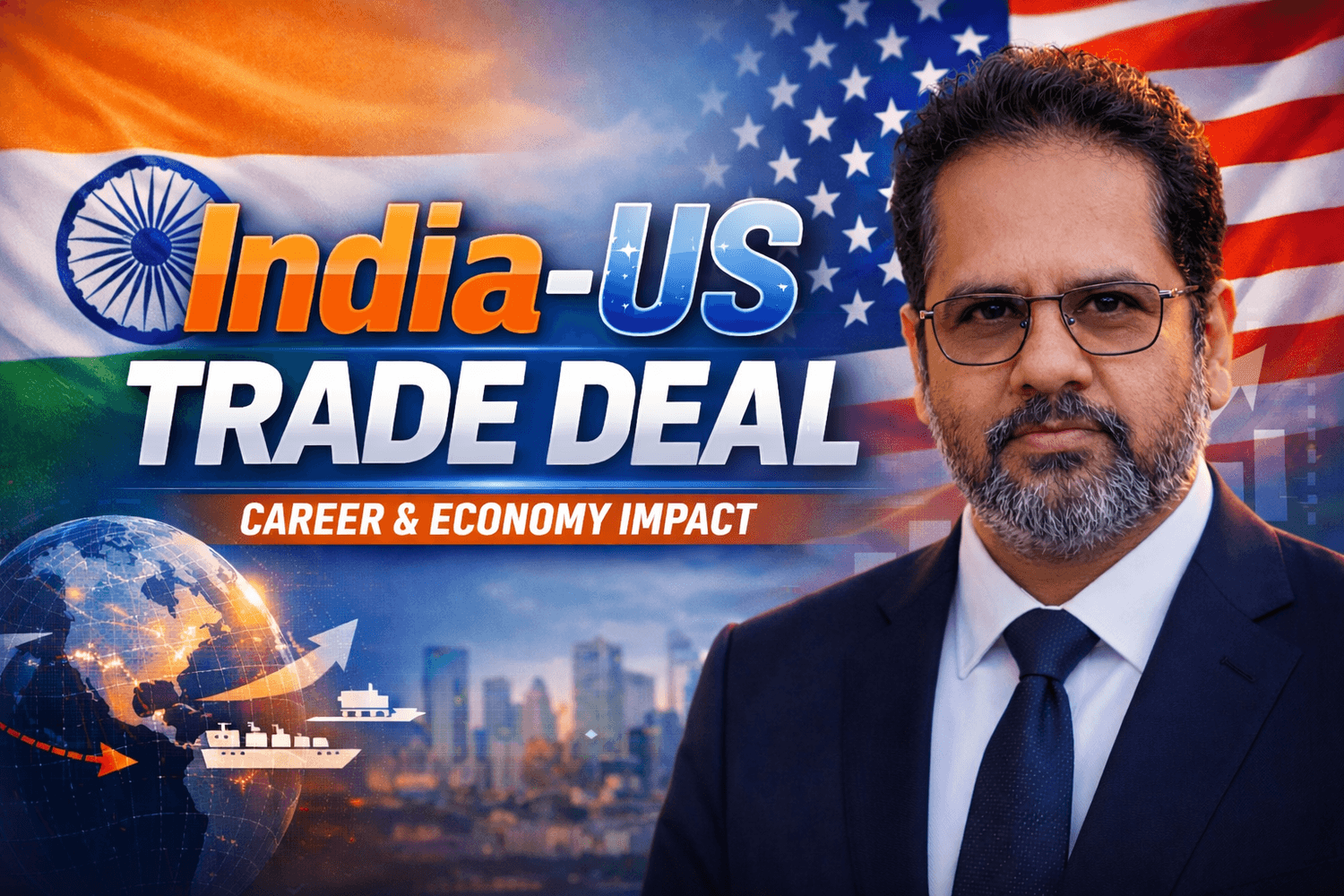
India–US Trade Deal 2026
Why the India–US Trade Deal Matters More Than Ever
India and the United States already share one of the most important strategic economic relationships in the world.
By 2026, this relationship is not defined by a single treaty but by a series of structured trade arrangements, sector-specific agreements, and strategic economic cooperation frameworks.
When people refer to the “India–US Trade Deal 2026,” they are referring to the evolving bilateral trade architecture aimed at expanding trade volumes, reducing friction, strengthening supply chains, and deepening economic ties.
This blog explains what is actually happening, what is officially known, and how it impacts businesses, professionals, and the Indian economy.
Current Status of India–US Trade Relations
As of 2025–26:
The United States is one of India’s largest trading partners
Bilateral trade in goods and services has crossed USD 190 billion
Both countries have publicly committed to expanding trade beyond USD 500 billion in the long term
India and the US do not have a comprehensive Free Trade Agreement, but operate through sectoral agreements and trade dialogues
This makes the India–US relationship incremental, strategic, and pragmatic, rather than treaty-heavy.
What the “India–US Trade Deal 2026” Actually Refers To
There is no single signed FTA titled “India–US Trade Deal 2026.”
Instead, the term refers to a set of ongoing and planned initiatives, including:
Trade Policy Forum (TPF) engagements
Indo-Pacific Economic Framework (IPEF) participation
Critical and Emerging Technology Initiative (iCET)
Supply chain resilience partnerships
Defense and technology-linked trade agreements
These frameworks collectively shape trade outcomes.
Key Areas of Cooperation in 2026
1. Manufacturing and Supply Chains
India and the US are actively working to reduce supply chain dependence on limited geographies.
Key focus sectors:
Electronics and semiconductors
Pharmaceuticals and medical devices
Critical minerals and clean energy components
Advanced manufacturing
India is positioning itself as a manufacturing and supply chain alternative, supported by Production Linked Incentive (PLI) schemes.
2. Technology and Digital Trade
Technology is central to India–US trade growth.
Key facts:
The US remains the largest market for Indian IT and digital services
Indian tech talent plays a major role in US innovation ecosystems
Cooperation is expanding in AI, semiconductors, quantum computing, and cybersecurity
Data protection, digital trade rules, and cross-border data flows remain areas of structured discussion rather than conflict.
3. Defense and Aerospace Trade
India is among the largest defense importers globally, and the US has become a major defense trade partner.
Key developments:
Increased procurement of US defense platforms
Joint production and technology transfer discussions
Defense trade exceeding USD 20 billion
Defense trade is linked closely with strategic trust rather than pure commercial terms.
4. Energy and Sustainability
India and the US are collaborating on:
Clean energy
LNG trade
Climate finance
Green hydrogen
The US is a major supplier of LNG to India, helping India diversify energy sources while supporting US exports.
What India Gains From This Trade Relationship
1. Market Access
The US remains a high-value market for:
IT services
Pharmaceuticals
Engineering goods
Textiles and specialty manufacturing
Indian exporters benefit from scale, pricing power, and long-term demand stability.
2. Investment and Capital Flow
US companies are among the largest investors in India.
Key areas:
Technology
Manufacturing
Financial services
Startups
This supports job creation, skill development, and innovation.
3. Strategic Leverage
Trade with the US strengthens India’s position in:
Global supply chains
Geopolitical negotiations
Technology ecosystems
This relationship is as much strategic as it is economic.
What the US Gains From India
From the US perspective, India offers:
A fast-growing consumer market
A trusted strategic partner
Skilled workforce
Supply chain diversification
India’s scale and demographic advantage make it indispensable to long-term US economic planning.
Challenges and Open Issues
Despite strong cooperation, some issues remain under discussion:
Tariff disputes in select sectors
Agricultural market access concerns
Data localization and digital regulation differences
Visa and professional mobility limitations
These are handled through dialogue mechanisms rather than trade retaliation.
Impact on Indian Businesses and Sales Professionals
For Indian businesses, this relationship means:
More opportunities in B2B and B2G contracts
Higher compliance and quality expectations
Increased competition from US firms in India
Greater demand for consultative, global-standard selling
US buyers value:
Clarity
Compliance
Documentation
ROI-focused communication
Sales approaches must match this mindset.
Impact on the Indian Economy
Fact-based outcomes:
Export growth diversification
Increased foreign direct investment
Technology transfer and skill upgrading
Strengthened macroeconomic resilience
The relationship supports India’s long-term growth trajectory rather than short-term trade surpluses.
What This Means Going Into 2026
The India–US trade relationship in 2026 is defined by:
Strategic alignment
Sector-driven growth
Gradual friction reduction
Long-term cooperation
It is not a sudden breakthrough, but a steady expansion built on trust, shared interests, and mutual economic benefit.
Conclusion: A Relationship Built on Strategy, Not Headlines
The India–US Trade Deal narrative is often oversimplified.
The reality is more nuanced, more stable, and more powerful.
This is a relationship driven by:
Technology
Trust
Talent
Strategic alignment
Businesses and professionals who understand this depth will be better prepared to leverage opportunities in the coming decade.
Your Next Step
If you want to build global selling skills, understand international buyer expectations, and prepare yourself for cross-border opportunities, start with my free guide:
👉 5 Secrets to Become a Top 1% Sales Professional
📲 Or message me directly on WhatsApp at +91 9348101001 for guidance on global sales readiness.
Pro Tip:
Global trade success belongs to those who understand facts, not hype.

Hey.. I am Bharat Ogirala
Bharat Ogirala, a leading sales coach in India with 22+ years’ experience, has trained 15,000+ professionals, empowering them to excel in sales, leadership, and business growth.






JOIN MY MAILING LIST
The Sales Gurukul is a tech-enabled sales enablement platform founded by Bharat Ogirala. The platform focuses on building structured, system-led sales capability through digital learning paths, practical frameworks, and execution support for sales professionals and organizations.
Contact: +91 9348101001
The Sales Gurukul is a Government of India recognized MSME (Udyam Registered Enterprise).
Follow us on


© 2026 The Sales Gurukul. All rights reserved.