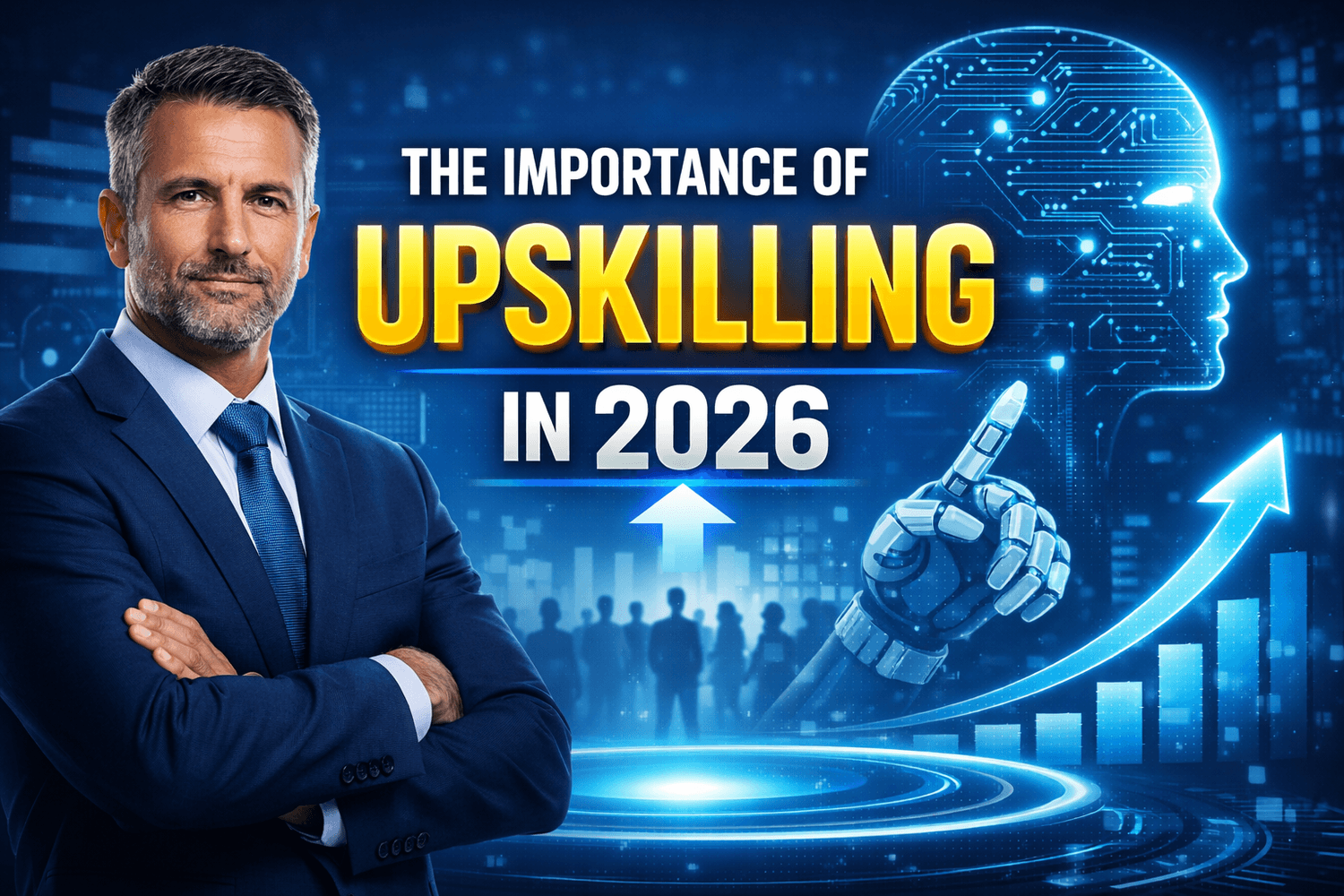
The Importance of Upskilling in 2026
Why Standing Still Is the Fastest Way to Fall Behind
Last month, I spoke to a senior sales leader who had 18 years of experience. Strong track record. Loyal to his company. Solid network.
Yet he looked worried.
He said, “Bharat, I feel like the ground is moving under my feet. AI tools, automation, changing buyer behavior. I am experienced. But I am not sure I am relevant.”
That sentence hit hard.
Because in 2026, experience alone is not enough. Titles are not enough. Even past success is not enough.
The professionals who will dominate 2026 and beyond are not the most experienced. They are the most adaptable.
And adaptability is built through upskilling.
In this blog, I will show you why upskilling is no longer optional, what skills matter most in 2026, and how you can build a practical, structured upskilling roadmap that protects your career and accelerates your growth.
Let us begin.
1. The 2026 Reality: What Has Changed
We are not entering a slow shift. We are in the middle of a rapid transformation.
Here is what I see across industries:
1. AI Is Not Replacing You. But Someone Using AI Will.
Every function now has AI tools.
1. Sales teams use AI for prospect research, email personalization, pipeline forecasting, and objection handling simulation.
2. Marketing teams use AI for content creation, ad optimization, and data 3. analytics.
4. HR uses AI for screening and skill mapping.
5. Finance uses AI for forecasting and risk analysis.
The question is simple.
Are you learning to work with these tools?
Or are you hoping your current skills will protect you?
In 2026, productivity gaps will widen dramatically between those who upskill and those who resist.
2. Skills Have a Shorter Shelf Life
Earlier, a skill lasted 10 to 15 years.
Today, some skills become outdated in 3 to 5 years.
For example:
Traditional cold calling scripts without personalization no longer work.
Manual reporting without automation wastes time.
Purely transactional selling struggles in consultative markets.
The market evolves faster than corporate training calendars.
That is why you must own your development.
3. Employers Hire for Capability, Not Loyalty
Let me be honest.
Companies appreciate loyalty. But they reward impact.
If someone can deliver faster results using modern tools and sharper skills, organizations will choose performance over tenure.
In 2026, your employability depends on your capability, not your history.
Upskilling is your insurance policy.
2. What Upskilling Really Means in 2026
Upskilling is not just attending a webinar.
It is not watching random YouTube videos.
It is not collecting certificates.
Upskilling in 2026 means:
Building relevant, future-proof skills
Applying them immediately
Measuring impact
Continuously upgrading
Let me break this into a practical framework.
3. The 4D Upskilling Framework
I use a simple framework with my clients. I call it the 4D Framework.
1. Diagnose
First, you must diagnose your current skill gap.
Ask yourself:
What skills are becoming more important in my industry?
What tools are my competitors using?
Where am I slower than others?
What feedback do I keep receiving?
For example, if you are a sales manager in 2026, key skills may include:
Data-driven selling
AI-assisted prospecting
Consultative conversation design
Negotiation in complex environments
Virtual presentation mastery
If you cannot confidently perform in these areas, that is your gap.
Be brutally honest.
2. Decide
Do not try to learn everything.
Focus on high-leverage skills.
High-leverage skills have three qualities:
They increase revenue or efficiency.
They differentiate you from peers.
They remain relevant for several years.
For example:
Instead of learning 10 small tools, learn one AI-powered CRM deeply.
Instead of attending five generic leadership sessions, master structured coaching frameworks.
Precision beats overload.
3. Develop
Now comes structured development.
In 2026, development should follow this ratio:
20 percent theory
80 percent application
For example:
If you learn AI-powered prospecting, immediately:
Use AI to analyze your top 50 accounts.
Personalize outreach using data insights.
Track response rates.
Refine weekly.
Learning without implementation creates false confidence.
Implementation creates competence.
4. Demonstrate
Finally, demonstrate your upgraded capability.
Publish insights on LinkedIn.
Lead internal training sessions.
Share case studies.
Show measurable results.
Visibility multiplies value.
When you demonstrate skills publicly, opportunities find you.
4. The Most Critical Skills to Upskill in 2026
Now let us get specific.
Here are the core skill clusters that will define top performers in 2026.
A. AI and Digital Fluency
You do not need to become a coder.
But you must:
Use AI tools for research and productivity
Understand data dashboards
Interpret analytics
Automate repetitive tasks
Example:
One sales professional I coached reduced his proposal preparation time from 3 hours to 45 minutes using AI drafting and templates. That gave him 2 extra hours daily for client engagement.
That is competitive advantage.
B. Strategic Thinking
Operational execution is expected.
Strategic thinking is rare.
In 2026, leaders must:
Connect daily tasks to business goals
Analyze trends
Anticipate risks
Design long-term plans
If you only execute instructions, you remain replaceable.
If you think strategically, you become indispensable.
C. Communication and Influence
Technology is rising.
But human persuasion still wins deals.
The professionals who will win in 2026 can:
Simplify complex ideas
Tell compelling stories
Influence stakeholders
Handle objections calmly
Present confidently online and offline
I have seen technically brilliant professionals lose deals because they could not articulate value clearly.
Communication is no longer a soft skill.
It is a revenue skill.
D. Adaptability and Learning Agility
The world will keep changing.
The most valuable skill is the ability to learn quickly.
Learning agility includes:
Curiosity
Openness to feedback
Willingness to experiment
Comfort with uncertainty
If you resist change, you slow your own growth.
If you embrace it, you accelerate.
5. Upskilling for Sales Professionals in 2026
Since sales is my core domain, let me go deeper here.
Sales in 2026 is:
More data-driven
More consultative
More technology-enabled
More competitive
If you are in sales, you must upskill in:
1. Consultative Selling
Stop pitching.
Start diagnosing.
Learn to:
Ask structured discovery questions
Quantify business impact
Build ROI-based conversations
2. Sales Technology Stack
Master:
CRM optimization
AI-based lead scoring
Automation workflows
Pipeline analytics
Your ability to read data can double your performance.
3. Negotiation in Complex Environments
Clients are smarter.
Procurement teams are sharper.
You must:
Understand value-based pricing
Handle multi-stakeholder negotiations
Defend margins confidently
4. Personal Branding
In 2026, buyers research you before responding.
If your digital presence is weak, trust reduces.
Build:
Strong LinkedIn content
Insightful posts
Case studies
Testimonials
Visibility builds credibility.
6. Real-World Example: Two Managers, Two Paths
Let me tell you a simple story.
Manager A had 15 years of experience. He relied on traditional methods. He avoided new tools. He said, “This is how we have always done it.”
Manager B had 10 years of experience. He actively learned AI tools. He analyzed data weekly. He redesigned his sales conversations. He trained his team continuously.
Within 18 months:
Manager B’s team grew revenue by 28 percent.
Manager A’s team stagnated.
Experience did not fail Manager A.
Complacency did.
Upskilling separated growth from stagnation.
7. A Practical 90-Day Upskilling Plan
Let me give you something actionable.
Here is a simple 90-day structure.
Days 1 to 30: Awareness and Foundation
Identify 2 critical skills.
Enroll in structured learning.
Study 30 minutes daily.
Map learning to your job.
Days 31 to 60: Application
Apply new skills weekly.
Track measurable results.
Seek feedback from peers or mentors.
Refine approach.
Days 61 to 90: Optimization and Visibility
Document case studies.
Share learning publicly.
Train your team.
Measure business impact.
After 90 days, repeat with new skills.
Continuous improvement beats one-time effort.
8. The Cost of Not Upskilling
Let us talk honestly.
The cost of upskilling includes:
Time
Effort
Money
But the cost of not upskilling is far higher.
It includes:
Career stagnation
Reduced income growth
Job insecurity
Lower confidence
Missed leadership opportunities
In 2026, irrelevance is expensive.
Relevance is profitable.
9. My Personal Commitment to Continuous Upskilling
Even after two and a half decades in sales and leadership, I still learn daily.
I study AI applications in sales.
I refine frameworks.
I test new strategies with clients.
I reinvent content delivery.
Because I know one truth.
The day I stop learning is the day I start declining.
And I refuse to decline.
You should too.
Conclusion: Upskilling Is Your Competitive Moat
In 2026, the world will not slow down for you.
Technology will advance.
Buyer expectations will rise.
Competition will intensify.
You have two choices.
React when forced.
Or prepare in advance.
> Upskilling builds confidence.
> Upskilling increases income potential.
> Upskilling protects employability.
> Upskilling positions you for leadership.
> Most importantly, upskilling keeps you relevant.
And relevance creates opportunity.
Your Next Step
If you want to design a structured upskilling roadmap for yourself or your team in 2026, let us build it together.
Message me directly on WhatsApp at +91 9348101001.
Let us future-proof your career.

Hey.. I am Bharat Ogirala
Bharat Ogirala, a leading sales coach in India with 22+ years’ experience, has trained 15,000+ professionals, empowering them to excel in sales, leadership, and business growth.






JOIN MY MAILING LIST
The Sales Gurukul is a tech-enabled sales enablement platform founded by Bharat Ogirala. The platform focuses on building structured, system-led sales capability through digital learning paths, practical frameworks, and execution support for sales professionals and organizations.
Contact: +91 9348101001
The Sales Gurukul is a Government of India recognized MSME (Udyam Registered Enterprise).
Follow us on


© 2026 The Sales Gurukul. All rights reserved.